

How to republish
Read the original article and consult terms of republication.
Are teenagers now entrusting their secrets to artificial intelligence?
By Fabrice Lollia, Doctor of Information and Communication Sciences, Université Gustave Eiffel.
Credit : Fabio Principe / AdobeStock_529421710
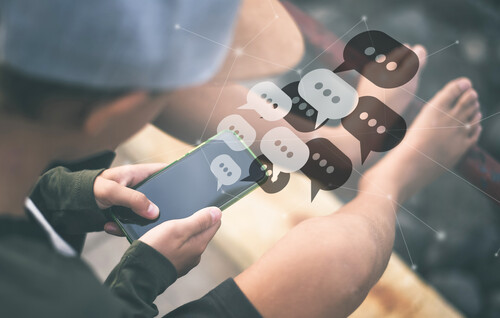
Teenagers have long poured their heart out in diaries, on blogs or in conversations with friends, and now, they are readily confiding in artificial intelligence platforms. This practice needs to be addressed so as to better prevent risks.
Large language models such as ChatGPT and specialist platforms such as Replika – where you can personalise an AI by even giving it a first name and a voice – are gradually establishing themselves as confidants in the world of teenagers. These tools are always available, responding without judgement and giving the illusion of an attentive ear, making them appealing to young people looking for reassurance or advice.
However, this apparent benevolence is not without risk, such as emotional dependence, exposure to inappropriate or even dangerous responses, and damaged confidentiality of personal data.
This phenomenon is still largely underestimated, and reveals the emergence of a new type of vulnerability that calls for increased vigilance. How can we understand why the expression of adolescent intimacy is sliding towards these algorithm-based technologies? And what are the communication, psychosocial and ethical implications?
From diary to chatbot: a new medium for expressing confidences
For a long time, adolescent confidences were the domain of diaries, exchanges between friends or conversations with trusted adults. But now, they are migrating towards technological contexts. What we are seeing here is a form of inverted parasocial relationship, where the chatbot gives the illusion of reciprocity and benevolent listening, whereas these responses are based solely on algorithmic logic.
According to a survey by Common Sense Media, nearly 72% of teenagers in the United States have used an “AI companion”. More than half (52%) are regular users and 13% use it daily. Entertainment (30%) and curiosity (28%) are the main motives, but a significant proportion are more personal, seeking advice (14%) and above all, the ability to confide the unspeakable (12%), i.e. things they do not feel they can share with friends and family.
These statistics testify to a ubiquity that has become almost invisible in everyday life. A recent study confirms this trend in France. It reveals that 80% of young people are already using artificial intelligence in their daily lives, even though 93% say it could never replace human interaction.
Nearly one in five young people have tried out conversational AIs such as Character.AI or Snapchat's MyAI chatbot. These tools are mainly used as “virtual companions” (28%) or “mental health coaches” (16%). For many teenagers, they are a temporary remedy for loneliness (35%) or boredom (41%).

Credit : naufal / AdobeStock_1752059156
Figures from the study show that almost 75% of teenagers have interacted with a “virtual AI companion”, whether to chat, flirt or seek emotional support. Uses fall into three main categories:
- emotional regulation (externalising anxiety, verbalising doubts);
- practical and personal guidance (relationships, sexuality, family conflict);
- externalisation of the self (digital journaling, non-judgemental conversation).
These practices mainly concern extremely online digital natives, but also teenagers who are reluctant to confide in their family and friends. Furthermore, an Odoxa poll shows that younger people have more confidence in AI, while older people are more wary.
Here, we find a classic mechanism described in information and communication science, where technology occupies the space left vacant by interpersonal communication that is deemed unsatisfactory.
A wide range of risks
Firstly, it has been shown that some teenagers develop genuine romantic attachments to AI, which can reshape their relationship expectations and therefore engender emotional risk.
The social risk also needs to be considered, insofar as the frequent use of chatbots can isolate people, leading them to no longer accept any form of contradiction, having entered bubbles of filters that confirm their beliefs.
Secondly, research has shown that LLMs sometimes produce biased or erroneous responses, known as “hallucinations”, which increases the risk of inappropriate guidance.
Media coverage of cases involving chatbots inciting people to violence or suicide highlights the critical risk associated with these technologies. Such episodes show that interaction with conversational AI can become an aggravating factor for vulnerable groups, particularly minors and people with severe mental health disorders.
Furthermore, confiding personal information exposes users to issues of privacy and digital traceability, problems that are exacerbated by age and a lack of knowledge of the conditions of use, thereby fuelling the information risk.
Teenagers are now exposing their private lives to algorithmic technologies, designed by private players whose aim is not to provide mental health support, but to capture and exploit data. Research shows that digital memory is oriented towards preserving, filtering and reconfiguring traces. In this case, it archives and shapes adolescent subjectivity, which raises profound questions about the construction of young people's identities and relationships.
In view of this, an outright ban seems unrealistic. Three courses of action seem more relevant:
- a technological framework designed to incorporate specific safeguards for minors (redirection to human-based resources, increased moderation);
- education in communication to help young people, teachers and parents learn to decode and contextualise these uses;
- shared governance involving families, teachers, health institutions and platforms to co-construct appropriate standards.
Private lives shifting under the influence
The widespread use of artificial intelligence not only affects the mental development of young people, but also the reconfiguration of our societies' systems of trust. The authenticity of human relationships is giving way to a sort of artificial parasocial relationship, shaped by technological and economic dynamics.
Faced with this shift, there are three key areas for action:
- scientific action, to document the extent and impact of these uses;
- educational action, to equip young people with appropriate emotional and digital literacy skills;
- political action, to regulate the practices of platforms and protect the rights of minors.
The question is not whether teenagers will continue to confide in AIs (this is already the case), but rather to determine under what conditions these confidences can be heard without becoming a major risk to their autonomy and mental health.
Identity card of the article
Original title: | Les adolescents confient‑ils désormais leurs secrets aux intelligences artificielles ? |
Author: | Fabrice Lollia |
Publisher: | The Conversation France |
Collection: | The Conversation France |
Licence: | This article is republished from The Conversation France under Creative Commons licence. Read the original article. An English version was created by Fluent Planet for Université Gustave Eiffel and was published by Reflexscience under the same license. |
Date: | April 28, 2026 |
Languages: | French and English |
Key words: | Algorithms, generative artificial intelligence, psychology, teenagers |
![[Translate to English:] Licence creative commons BY-SA 4.0](https://reflexscience.univ-gustave-eiffel.fr/fileadmin/ReflexScience/Accueil/Logos/CCbySA.png "[Translate to English:] Licence creative commons BY-SA 4.0")