

How to republish
Read the original article and consult terms of republication.
Deepfakes and elections in Africa: the next great threat to democracy?
By Fabrice Lollia, Doctor of Information and Communication Sciences, Université Gustave Eiffel.
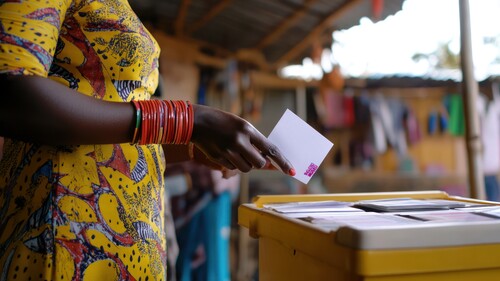
African elections are already marked by recurring tension over transparency and disinformation. However, they could soon be entering a new era, that of deepfakes. This video and audio content generated by artificial intelligence (AI) is capable of imitating a person's voice, face and gestures with disturbing realism, shifting the boundaries of political manipulation.
While deepfakes may be amusing when featuring celebrities in humorous reimaginings, during election periods, this content represents a serious threat to the stability of democracies. In the United States, India and Slovakia, it has already been used to influence public opinion. The central question is therefore very simple: is Africa ready to confront this new tool for electoral manipulation?
As a researcher in information and communication science (ICS), I study the circulation of information, disinformation and communication vulnerability in crisis situations. The emergence of deepfakes illustrates these tensions. In Africa, where the electorate is dominated by hyper-online young people but digital literacy remains uneven, the risk is particularly high. In this article, I propose an analysis of African elections through a communication studies lens.
Worrying precedents worldwide
Deepfakes are no longer a futuristic hypothesis. They have already marked key elections, offering lessons for African countries. In 2023, a few days before the parliamentary elections in Slovakia, an audio deepfake was going around on Facebook and Telegram. It was a conversation attributed to Michal Simecka, leader of the pro-West Progressive Slovakia party, which showed him planning to rig the ballot. This content sowed doubt, swinging voters towards Robert Fico's populist party. It was the first documented case of a deepfake influencing a national election in Europe.
In 2024, during the New Hampshire Democratic primary in the United States, voters received a deepfake phone call imitating Joe Biden's voice and urging them to abstain. This is a case that illustrates the use of deepfakes to discourage voter turnout, a direct attack on democracy.
The 2024 general elections in India were marked by an explosion of deepfakes. AI-generated video and audio content were spread on a massive scale via social media. Bollywood actors and even deceased political figures were used to support or attack the candidates.
These examples show that the aim of deepfakes is not just to convince, but above all to seed doubt, blur lines and undermine trust.
A fertile environment in Africa
There are now more than 670 million Internet users on the African continent, most of them young. WhatsApp, Facebook and TikTok have become the main sources of political information. In this context, several factors increase people's vulnerability to deepfakes:
- Poor fact-checking culture: many users share content without verifying its source;
- Extreme virality: messages and videos circulate quickly in closed groups and are difficult to monitor;
- Contested electoral institutions: public confidence is fragile, which lends greater credibility to false information.
Minor signals are already appearing:
In Nigéria in 2023, concerns arose about the circulation of manipulated videos during the presidential elections.
In Kenya in 2022, TikTok and Facebook hosted a large amount of manipulated political content, some of it using forgery techniques, as part of disinformation campaigns.
Africa is therefore in a phase of latent vulnerability, accumulating all the ingredients for deepfakes to rapidly become a political weapon. Unlike traditional “fake news”, deepfakes draw their strength from the synergy of image and sound, creating a sensory illusion that is difficult to contest. Their effectiveness lies not only in their ability to deceive, but also in their power to symbolically destabilise.
They can create a scandal around a candidate, amplify ethnic or religious divisions, and sow confusion.
This erosion of the truth contract is a major communication crisis that is undermining African democracies, which already face precarious balances around their institutions.
An analysis through a communication studies lens
Through ICS, we can analyse this phenomenon from a broader angle. Three areas are particularly relevant:
- Firstly, from a mediology and rumour circulation perspective, deepfakes are part of a long history of using communication technologies as instruments of power. Uncertainty, lack of transparency and the opacity of certain spheres of information encourage the proliferation of rumours, particularly in electoral or political contexts. Deepfakes add a technological layer, giving a veneer of credibility to the rumour.
- Secondly, the socio-technological logic of platforms means that algorithms favour sensational and polarising content, such as on TikTok. In these systems, deepfakes become an algorithmic weapon amplified by the attention economy.
- Lastly, in an African context marked by linguistic, educational and technological divides, the reception of deepfakes varies greatly. Varying levels of digital literacy mean different levels of appropriation, accentuating asymmetries of understanding.
A number of solutions are emerging, but implementation remains complex: Google, Meta and Microsoft are developing tools capable of identifying artificial content. But these detection technologies are still expensive and rarely accessible to the African media.
Initiatives such as Africa Check play a crucial role in terms of media and fact-checking, but they are not big enough to take on the flood of manipulated information.
From a legal point of view, some African countries such as Ghana and Ouganda, are legislating against fake news. However, these laws have debatable frameworks and run the risk of serving political censorship rather than public protection. A pan-African approach via the African Union or regional communities would offer greater credibility.
Training people of all ages to identify, check and question content is a strategic investment for democracy. University curricula and media education are long-term levers, which must incorporate digital and media literacy as civic skills.
Towards digital sovereignty in Africa?
The threat of deepfakes is also an invitation to reflect on African digital sovereignty. Africa cannot depend solely on Western technology giants to secure its information space. The development of pan-African research and detection laboratories paired with civil society initiatives could provide an endogenous response.
In addition, South-South cooperation (between India and certain African countries, for example) could encourage the exchange of technical and educational solutions. It is not just a question of fighting manipulation, but also of building a shared digital culture capable of restoring public confidence.
The cases in Slovakia, India and the United States show that deepfakes are already a formidable electoral weapon. In Africa, it is only a matter of time before they are introduced into the political game.
But the threat is not limited to technology. It reveals a deeper communication vulnerability, characterised by a crisis of confidence undermining democratic legitimacy. The challenge is therefore not just to detect deepfakes, but to rebuild a relationship of truth between citizens and governments.
Training the public, strengthening the media, developing local research and promoting pan-African regulation are all ways of tackling this challenge. Beyond technology, it is Africa's ability to protect the integrity of its democratic choices that is at stake.
Identity card of the article
Original title: | Deepfakes et élections en Afrique : la prochaine grande menace démocratique ? |
Author: | Fabrice Lollia |
Publisher: | The Conversation France |
Collection: | The Conversation France |
Licence: | This article is republished from The Conversation France under Creative Commons licence. Read the original article. An English version was created by Fluent Planet for Université Gustave Eiffel and was published by Reflexscience under the same license. |
Date: | February 9, 2026 |
Languages: | French and English |
Key words: | Africa, artificial intelligence (AI), deepfakes, digital sovereignty, disinformation, elections, fake news, media, Meta, technology, TikTok |
![[Translate to English:] Licence creative commons BY-SA 4.0](https://reflexscience.univ-gustave-eiffel.fr/fileadmin/ReflexScience/Accueil/Logos/CCbySA.png "[Translate to English:] Licence creative commons BY-SA 4.0")