

How to republish
Read the original article and consult terms of republication.
Madagascar: the key role of social media in the government’s fall from power
By Fabrice Lollia, Doctor of Information and Communication Sciences, Université Gustave Eiffel.

There are multiple causes of the Malagasy crisis, but the successful mobilisation of society – dominated by young people – is largely due to the central role now played by social media. This is what facilitated the dissemination of anti-government rhetoric, made it possible to coordinate protest actions and provided soldiers who broke with the government with a platform to express their support for the revolt, which recently resulted in the National Assembly's proclamation of the President's impeachment.
On 25 September 2025, Antanarivo was plunged into a major socio-political crisis. What began as a local rally against frequent power cuts turned into a national protest movement, driven, in part, by a hyper-online youth and amplified by social media.
In just a few days, the protests spread. The UN Office of the High Commissioner for Human Rights put the death toll from the crackdown at 22, with another 100 injured (disputed by the Malagasy government). The government was dissolved, and the Army Corps of Personnel and Administrative and Technical Services (CAPSAT) joined the demonstrators to take over the Place du 13 Mai, a symbol of victory against the current government.
President of the Republic Andry Rajoelina left the country on 12 October, exfiltrated by a French military aircraft. While he was refusing to resign, denouncing what he described as an attempt to seize power by force, and claiming to have been the victim of an assassination attempt, the National Assembly voted to remove him from office on 14 October and an army unit supporting the protesters announced that it was taking power.
While it is not easy to predict what will happen next, we can already analyse the mechanisms that enabled the protesters to mobilise so quickly and effectively. It appears that information – circulation, framing and timing – has become a central political battleground. In Madagascar, as elsewhere, power is also wielded in the digital public sphere.
Applying the tools of information and communication science (ICS) to our interpretation of this series of events can help us to understand how social media can catalyse mobilisation, undermine political regimes and redefine the relationship between citizens, media and institutions.
A political shift shaped by information
From the outset, videos showing looting and clashes between protesters and the forces of law and order spread widely across social media.
These images, often filmed by ordinary citizens, had a twofold effect.
On the one hand, by bluntly highlighting the authorities' loss of control and their use of violence, they fuelled collective indignation. On the other, they helped shape a political narrative of the crisis: people resisting a government that they consider to be failing them.
This dynamic is based on the principle of the power of framing of viral images. In other words, what matters is not just what is shown, but the way in which content is circulated, commented on and aggregated in extremely short timeframes.
In a context where the traditional Malagasy media adopt a cautious approach to reporting – often marked by self-censorship or proximity to official narratives – digital platforms are emerging as the central arena for the production and legitimisation of political discourse. This configuration evokes what Bernard Miège (2007) describes as “a society conquered by communication”, where flows of information structure social relationships faster than institutions can react.
Generation Z, a new political player
The movement in Madagascar was driven by Generation Z : young city-dwellers who are connected, familiar with online culture and often critical of the political elite. They are not content to simply consume information. They produce, relay and script it collectively.
Coordinated hashtags (#RajoelinaDemission, #May13) marked the protests; collaborative maps showing roadblocks were shared in real time; Facebook livestreams turned every moment, every event, into a political platform.
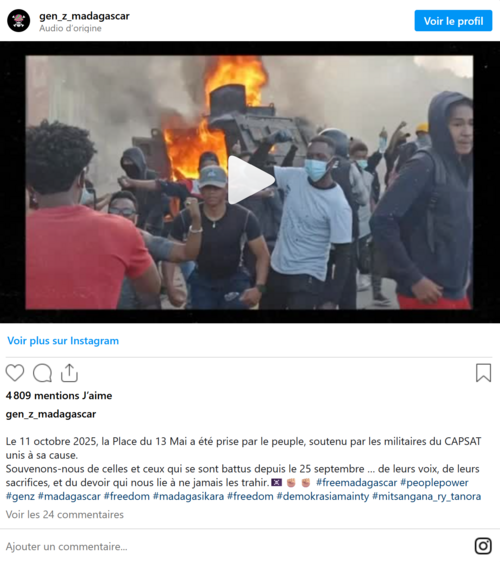
This horizontal approach, with no single leader, threw the institutions off balance. It is a perfect illustration of how public space is changing. Alongside structured organisations (parties, trade unions), networks of connected individuals produce and amplify collective action, forming part of an agonistic digital public sphere, i.e. a space where confrontation between opinions, emotions and stories replaces traditional forms of public deliberation. In this context, power is no longer solely based on the content of messages, but on the ability to connect and mobilise active audiences capable of imposing their own rhythm on the political debate.
Information interference and vulnerability
The Malagasy crisis is not exclusively endogenous. There are signs of cross-platform synchronisation and rapid dissemination of hashtags from overseas accounts, potentially linked to regional activist networks or hybrid players, in dynamics of cyberactivism and digital geopolitics.
But in a country where the government has no structured information monitoring and response strategy comparable to Viginum in France, it has to be said that the field is open to external amplification campaigns, which exploit collective emotions to accentuate internal polarisation.
This situation reveals a structural communicational vulnerability, i.e. the inability of many fragile democracies to anticipate transnational informational dynamics. This raises the question of information sovereignty – a crucial issue today, on par with military or energy security.
The army enters the digital arena
When the CAPSAT soldiers decided to support demonstrators, the first battle was fought not in the street but on social media. Videos showed soldiers marching alongside the crowd. These images were broadcast live, shared on a loop and commented on massively.
Even before taking concrete military action, the army acted symbolically, in the digital space. This public display had immediate political effects, as it undermined the President's authority, gave the protesters confidence and shifted the balance of power in the collective imagination.
In ICS, we talk about communicative performativity. This means that communicating becomes an act in itself, capable of producing real effects. The images and messages from the soldiers were not simply testimonies. They instantly transformed the political situation. From this perspective, the army was no longer content to be a traditional armed force; it also became an actor in the media, capable of influencing opinion and power relations through digital and symbolic means.
It is this hybrid between military action and online communication that characterises many contemporary political crises. During the coup d'état in Myanmar in 2021, the military broadcast their takeover live to impose a narrative of legitimacy; during the Egyptian revolution in 2011, the army used Facebook and television to symbolically ally itself with the people; in Sudan in 2019, military factions relayed their political positions online before taking any physical action, working to reshape the internal balance of power.
A framework for analysis through a communication studies lens
To analyse this series of events, we can use a simple framework based on four dimensions:
- The players: young people, the diaspora, the authorities, digital platforms;
- The media: Facebook, TikTok, citizen videos, hashtags, livestreams;
- The timeline: acceleration, the simultaneous nature of online and offline acts;
- The political effects: the government’s loss of legitimacy, the fragmentation of authority and the reforming of alliances.
This grid allows us to go beyond a purely events-based interpretation, to understand the structural logic at work. The case of Madagascar can be compared with other recent episodes, such as the youth movement in Senegal in 2024 or the recent Generation Z protests in Morocco. They all share the same characteristics: horizontal digital mobilisation, rapid destabilisation of the elite and hybridisation of spaces of action.
A laboratory for thinking about new public spaces
The crisis in Madagascar is revelatory in that it shows how social networks are not simply channels of communication, but political infrastructure capable of organising dissent, rebuilding alliances and weakening or even defeating established power. It illustrates the need for governments to develop information governance that combines public communication, digital education, monitoring systems and democratic mediation. Without such measures, societies become vulnerable to uncontrolled viral dynamics and external manipulation.
The Malagasy crisis cannot therefore be understood solely in political or economic terms. It is also, and above all, informational, in the sense that it is produced, amplified and structured by communication dynamics. It illustrates the way in which, in contexts of institutional fragility, social networks become powerful instruments capable of reshaping the power relationships between government, society and hybrid actors.
Faced with such shifts, government and civil society alike must learn to navigate a public sphere that has become profoundly digital, fluid and conflict-ridden, a major challenge for democratic governance in the 21st century.
Identity card of the article
Original title: | Madagascar : le rôle clé des réseaux sociaux dans la chute du pouvoir |
Author: | Fabrice Lollia |
Publisher: | The Conversation France |
Collection: | The Conversation France |
Licence: | This article is republished from The Conversation France under Creative Commons licence. Read the original article. An English version was created by Fluent Planet for Université Gustave Eiffel and was published by Reflexscience under the same license. |
Date: | April 27, 2026 |
Languages: | French and English |
Key words: | Africa, communication, generation Z, information, Madagascar, movement, people, protest, revolt, social media, young |
![[Translate to English:] Licence creative commons BY-SA 4.0](https://reflexscience.univ-gustave-eiffel.fr/fileadmin/ReflexScience/Accueil/Logos/CCbySA.png "[Translate to English:] Licence creative commons BY-SA 4.0")