

How to republish
Read the original article and consult terms of republication.
Madagascar: when power cuts trigger a security crisis amplified by social media
By Fabrice Lollia, Doctor of Information and Communication Sciences, Université Gustave Eiffel.
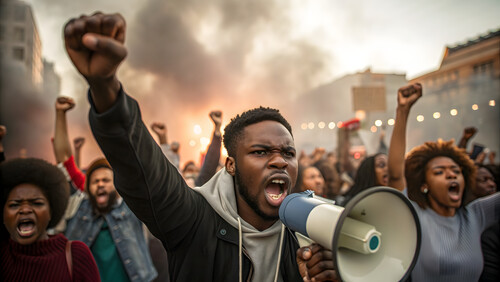
The Malagasy president has been contested since his re-election in 2023 and is currently facing a vast movement of revolt, triggered by water and power cuts due to poor governance and driven by the country's extremely online youth.
On 25 September 2025, Antananarivo was plunged into violence. What began as a protest by “Generation Z” against frequent water and power outages quickly turned into riots that resulted in supermarket looting, parliamentary residences set ablaze and a curfew introduced in the capital.
The death toll, disputed by the UN and the Malagasy presidency, is high. At least five people have been killed and a dozen injured. The immediate political repercussions were also striking, starting with the removal of the energy minister, followed a few days later by the resignation of the government.
These events reveal a major phenomenon: in the digital age, a failure of vital infrastructure is no longer just a technical problem. It can become the catalyst for social discontent amplified by social media, which accelerate the spread of anger, give it an emotional dimension and extend its reach.
The crisis in Madagascar provides a textbook case for analysing what could be called communication vulnerabilities at the intersection of security, infrastructure and governance.
Vital infrastructure as a trigger for protest
Electricity and water are the pillars of human security, as defined by the United Nations. Their absence is not merely a source of discomfort, but a threat to dignity and daily survival. In Madagascar, where poverty makes the population particularly vulnerable, repeated power cuts affect the conservation of foodstuffs, household security and continuity of economic activity.
The anger that is expressed therefore goes beyond a simple technical issue, reflecting a lack of confidence in the government's ability to fulfil its fundamental mission. This phenomenon is not unique. In South Africa, power cuts known as “load-shedding” have undermined the government and provoked numerous protests. In Nigeria, fuel shortages regularly trigger social unrest. In many cases, shortcomings in vital infrastructure become political tipping points.
Social media as an echo chamber of communication vulnerabilities
Contemporary protests are now played out in digital spaces. As Manuel Castells, showed, "communication is movement". In Antanarivo, as in other regions affected by protests, Facebook, WhatsApp and TikTok served as a vector for rapid mobilisation. Hashtags such as #LéoDélestage (“Fed Up With Load-Shedding”) have become shared slogans, enabling an online generation to give shape to its indignation.
Social media carried out three major functions:
Firstly, it made it possible to gather thousands of people in the city centre in just a few hours.
Secondly, the images from Antanarivo circulated in regions such as Antsirabe and Toasina, triggering a ripple effect.
Lastly, the videos of looting and fires had an ambivalent effect. On the one hand, their widespread distribution aroused fear and indignation while reinforcing the perception of a loss of control by the government; on the other, their viral nature gave unprecedented visibility to the movement, while reconfiguring its public image. These scenes served simultaneously as a catalyst for mobilisation for some and a deterrent for others, shaping the collective narrative of the crisis well beyond the actual events.
This viral logic, described by Dominique Cardon, is based on visible emotions rather than true facts. In this way, social media transforms a social protest into a national phenomenon, with unprecedented speed and intensity.
The crisis highlighted what Louise Merzeau calls "traces of memory". Each video and image shared becomes an immediate archive, inscribing the event in an irreversible temporality. But such memories are unstable and taken out of context, they are reconstituted each time they are shared, sometimes fuelling rumours.

We can identity three forms of communication vulnerability in this case:
The first comes from confusion around information.
All forms of content, whether verified, manipulated or “foreign" (i.e. produced outside the local context, by international players or by accounts with no direct link to the events), circulated simultaneously, creating informational noise that blurs the overall understanding of the situation.
The second comes from institutional silence, as the government was slow to communicate, leaving social networks to impose their own narrative. As Yves Jeanneret reminds us, information is a social mechanism and the absence of official discourse creates a vacuum that is filled by something else.
Lastly, citizens invested massively in digital platforms as new public spaces for deliberation and mobilisation, further reducing the scope and legitimacy of institutional discourse. The government’s vertical communication is thus challenged by a participatory and emotional horizontality.
The curfew response illustrates what Didier Bigo calls the trivialisation of the security exception. In this way, the emergency justifies the restriction of freedoms, but does not resolve the structural cause, i.e. the lack of infrastructure and trust.
From technical failure to political crisis: a fragile shift
These events are not taking place in a political vacuum. Since his disputed re-election in 2023, President Andry Rajoelina has faced opposition denouncing both fragile infrastructure and poor governance. The Malagasy population continues to be marked by a cycle of recurring political crises, where every dysfunction becomes an arena for confrontation between the party in power and those in opposition.
The load-shedding crisis quickly took on a political dimension. Some media outlets reported that representatives of the opposition highlighted their presence at the protests, giving the movement a political flavour. The Senate, for its part, denounced an “attempted coup d'état”. This rhetoric reflects the highly polarised nature of Malagasy politics.
This context accentuated a lack of trust, as citizens perceive load-shedding less as technical accidents and more as a sign of the government's structural incapacity. The lack of a rapid and transparent response exacerbated mistrust and gave social anger an immediately political dimension.
In the short term, a number of scenarios remain possible:
Night-time violence in Antanarivo could resume, particularly in commercial and outlying areas.
The crisis could extend to the regions, with movements already reported in Antsirabe and Tamatave (student mobilisation). Major secondary towns could be exposed through contagion.
There could be increased politicisation, as the visible presence of opposition Members of the National Assembly at the protests shows that the movement is being recovered over time.
These scenarios combine a risk of public disorder, economic disruption and political crisis.
The crisis in Madagascar illustrates a new paradigm. Security in the digital age is not just about preventing physical violence, but also about managing a more complex system involving three types of vulnerability:
Material vulnerability, characterised by vital infrastructure (energy, water, transport), symbolic vulnerability, characterised by digital communication (social media, virality), and institutional vulnerability, i.e. governance (legitimacy, capacity for mediation).
Crises arise through the interaction of these three dimensions. As Castells wrote, "power is now in the code and the flow”. Whoever controls the infrastructure and narrative controls social stability.
A simple episode of public anger?
The events of 25 September in Madagascar were not a simple episode of public anger. They are a paradigmatic case of how, in the digital age, a technical failure, although shaped by a specific cultural framework, can become a security crisis amplified by social media and revealing the fragility of governance.
Today's security depends as much on the robustness of infrastructure as on the ability to communicate and maintain trust. In this sense, Madagascar is a warning. The next security crisis could arise not from an attack or conflict, but from a power cut shared live on social media.
Identity card of the article
Original title: | Madagascar : quand les coupures d’électricité déclenchent une crise sécuritaire amplifiée par les réseaux sociaux |
Author: | Fabrice Lollia |
Publisher: | The Conversation France |
Collection: | The Conversation France |
Licence: | This article is republished from The Conversation France under Creative Commons licence. Read the original article. An English version was created by Fluent Planet for Université Gustave Eiffel and was published by Reflexscience under the same license. |
Date: | April 27, 2026 |
Languages: | French and English |
Key words: | Africa, generation Z, governance, infrastructure, Madagascar, mobilisation, protest, social media |
![[Translate to English:] Licence creative commons BY-SA 4.0](https://reflexscience.univ-gustave-eiffel.fr/fileadmin/ReflexScience/Accueil/Logos/CCbySA.png "[Translate to English:] Licence creative commons BY-SA 4.0")