

How to republish
Read the original article and consult terms of republication.
Marwan Barghouti, a figure of hope for a democratic Palestine
By Vincent Lemire, Professor of Contemporary History at Université Gustave Eiffel and Anna C. Zielinska, Lecturer in Moral Philosophy, Political Philosophy and Philosophy of Law, Member of Archives Henri-Poincaré, Université de Lorraine.
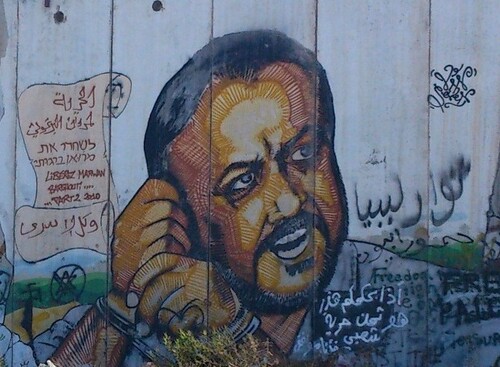
Credit : Ben Siesta / Wikipédia
Imprisoned for 23 years in Israel for crimes he has always denied, Marwan Barghouti, now aged 66, is the most popular political leader among the Palestinian population according to all opinion polls. If he were released and ran in the next presidential election promised by Mahmoud Abbas before the end of 2026, this Fatah leader could play a fundamental role in establishing a just and lasting peace between Israelis and Palestinians.
Determined to obtain Palestine’s independence within the 1967 borders, Barghouti is equally hostile to attacks on Israeli civilians. Around the world, but also in Israel itself, influential voices are calling for his release. For the time being, the Netanyahu government continues to oppose it.
Marwan Barghouti was born in 1959 in Kobar, not far from Ramallah. From 1994, he was Secretary-General of Fatah in the West Bank and, from 1996, a member of the Palestinian Legislative Council, the unicameral legislature of the Palestinian Authority, created by the Oslo Accords. A key figure in the second Intifada (2000-2005), he went underground in 2001 and has been imprisoned in Israel since 2002. The Palestinian leader has always denied having ordered the crimes for which he was sentenced to life imprisonment.
He is sometimes referred to as the "Palestinian Mandela". This analogy is disputed by some: while Barghouti took part in military actions, Nelson Mandela is said to have advocated for non-violent resistance as part of the African National Congress (ANC). However, that is not true. Mandela did, in fact, found, then lead from May 1961 onwards Umkhonto we Sizwe (Spearhead of the Nation), the military wing of the ANC.
Since his imprisonment 23 years ago, Barghouti's release was long demanded at international level, although only by left-wing political parties (the French Communist Party, in particular), but this demand has now become largely transpartisan. In January 2024, Ami Ayalon, former head of Shin Bet (Israel's domestic intelligence service), stated that Barghouti's release was essential to create a political alternative in Palestine, and therefore an effective process for peace. In early October 2025, Ronald Lauder, a key figure in the American Jewish community and President of the World Jewish Congress since 2007, offered to go in person to Sharm-el-Sheikh in Egypt (where negotiations between Israel and Palestine were taking place) to include Barghouti's release in the final ceasefire agreement, a proposal that was rejected by Benyamin Netanyahu.
Hadja Lahbib, the current European Commissioner for Preparedness and Crisis Management and former Belgian Minister for Foreign Affairs from 2022 to 2024, a member of the centre-right, recently said that she saw in Barghouti "the Palestinian Nelson Mandela" who could "win the confidence of his people while leading them towards peace".
Lastly, on 23 October 2025, Donald Trump, when asked about Barghouti in an interview with Time, replied:
"That was my question of the day. So I'll be making a decision."
The same magazine also reported that Marwan's wife, lawyer Fadwa Barghouti, had spoken directly to the American President to ask him to help secure her husband's release.
Although Benyamin Netanyahu is refusing to consider such a possibility, at present, his release seems less unlikely than in the past. But what does Marwan Barghouti really want, what influence does he have on the Palestinian political scene, and what could his possible release change?
Barghouti's political commitments
Barghouti holds a Master's degree in International Relations from Birzeit University (West Bank, Palestine), with a research dissertation on General de Gaulle's Middle East policy. He was arrested several times for his activities at the head of student organisations. During the first Intifada, he was exiled to Jordan (1987-1993). He was able to return to Palestine after the Oslo Accords and became Secretary-General of Fatah in the West Bank in 1994, as a fervent supporter of the peace process, while opposing the continuing colonisation.
During the second Intifada (2000-2005), he played a leading political role as leader of Tanzim, the “popular organisation” of Fatah, some of whose members joined the armed struggle. Tanzim's armed action was characterised by a rejection of suicide bombing and attacks on civilians, with actions concentrated on the Israeli occupation of Gaza and the West Bank. In August 2001, a few months before his arrest, his car was targeted by two anti-tank missiles and his bodyguard was killed. At his trial in 2004, Barghouti reiterated that his role within Fatah was primarily political and he has always denied having ordered the murders of which he was accused.
Several sources testify to the Palestinian leader's political plans. In 1994, in an interview with Graham Usher, Barghouti presented himself as a bridge between two Palestinian political cultures: one forged outside Palestine, the other under Israeli occupation. He sees the Oslo Accords as the end of the dream of a “Great Israel”, with the Israeli government recognising the Palestinians as a people and the Palestine Liberation Organisation (PLO) as its representative. In his view, independence was the movement’s priority objective, because it was the essential condition for the development of democracy in Palestine. He defended pluralism and feared that a Hamas victory in the 1996 legislative elections (in which the Islamist movement would not stand in the end) would lead to the introduction of Islamic law.
He advocated for the creation of genuinely democratic institutions in order to preserve pluralism, and pointed out that the future Palestinian government must respect the opposition. Lastly, he saw the PLO as a transitional stage in the process of setting up the Palestinian Authority, then the Palestinian State. He compares this role to that of the World Zionist Organisation, which he describes as “an international institution that facilitates and supports the right of return”. As he explains. his ideal Palestinian state is:
"A democratic state, founded on human rights and respect for the plurality of faiths and opinions. Everything that has historically been denied us in our fight for a homeland. For the Palestinians, nothing less will be acceptable."

Credit: IDF Spokesperson’s Unit, CC BY-ND
In another interview conducted in 2001, at the start of the second Intifada, Barghouti declared that “the aim of the Intifada is to put an end to the Israeli occupation”, which in concrete terms means ending the occupation of “all Occupied Territories” and establishing “an independent Palestinian state within the 1967 borders”. At the same time, a few months after the outbreak of the second Intifada and through the intermediary of a senior Shin Bet official, he proposed a credible truce to Israeli Prime Minister Ariel Sharon, which was refused. The fact that Barghouti has been in prison since 2002 did not prevent him from running in Palestine’s parliamentary elections in January 2006, the last to date, winning re-election by a wide margin.
A few months before his arrest in 2002, Barghouti published an article in the Washington Post “Want security? End the occupation”, in which he denounces Ariel Sharon's supposedly security-oriented arguments:
The only way for Israelis to have security is, quite simply, to end the 35-year-old Israeli occupation of Palestinian territory. Israelis must abandon the myth that it is possible to have peace and occupation at the same time, that peaceful coexistence is possible between slave and master. The lack of Israeli security is born of the lack of Palestinian freedom. Israel will have security only after the end of occupation, not before.
These words have lost none of their frontal clarity or force. In addition to the tragedy in Gaza, the occupation of the West Bank is causing incalculable damage to the Palestinians, of course, but also to Israeli society, which is gradually becoming gangrenous with the systematic and murderous brutality of its settlers and soldiers.

As philosopher Sari Nusseibeh said, Barghouti's commitment to a free and democratic Palestinian state was already apparent in the 1980s, when he was one of the few Palestinian activists to talk openly with Labour members of the Israeli Knesset. His position has remained unchanged since then. In the Washington Post article quoted above, Barghouti explains his strategic line:
"I, and the Fatah movement to which I belong, strongly oppose attacks and the targeting of civilians inside Israel, our future neighbor [...]. I do not seek to destroy Israel but only to end its occupation of my country."
In a letter written in 2016, he also stressed the far-reaching reforms that need to be undertaken in Palestine, to renew and consolidate the democratic contract between leaders and citizens:
"We cannot separate the liberation of the land and the liberation of the people. We need a revolution in our education, intellectual and cultural systems, as well as in our legal system."
What his release could bring
Barghouti is currently serving five life sentences. His trial did not meet international standards: Barghouti and his eminent lawyers – Jawad Boulus, Gisèle Halimi and Daniel Voguet, among others – argued that, under international law, the District Court of Tel Aviv did not have jurisdiction to try the charges against him. For this reason, Barghouti refused to respond in detail to the charges against him (the murder of the priest Georgios Tsibouktzakis and four other civilians), limiting himself to repeating his condemnation of terrorist attacks on civilians.
His popularity with the Palestinians is impressive. According to a May 2025 poll by the Palestinian Center for Policy and Survey Research, 39 % of voters in Palestine (West Bank and Gaza) consider Barghouti to be the most likely successor to Mahmoud Abbas, putting him in first place, well ahead of Khaled Mechaal, the political leader of Hamas exiled in Qatar, in second place with 12%.
Another poll carried out just before 7 October, in September 2023, to mark the 30th anniversary of the Oslo Accords, already showed that in the event of a presidential election, 34% of respondents would vote for Marwan Barghouti in the first round, and 17% for Hamas leader Ismail Haniyeh. In the second round, Barghouti would have easily won the vote against Haniyeh by 60%, while Haniyeh would have won by 58% against Mahmoud Abbas.
Not only is Barghouti the most popular figure among Palestinians, the bulwark against Hamas, but he also restores confidence in the political process itself. According to the same poll, voter turnout would be 20% higher if Barghouti is a candidate.
The release of Marwan Barghouti will not be enough to put an end to the conflict, which has lasted for more than a century. He is a human being who can make mistakes and who may propose certain solutions that turn out to be disappointing. But given what he represents for the Palestinians today, his release would appear to be an essential prerequisite for any political process.
Since the 1990s, he has made the fight against corruption and gender inequality the core of his commitments. He is the undisputed leader of the Prisoners' Movement, which brings together activists from all Palestinian factions, and works tirelessly for national reconciliation. In June 2006, he launched the Prisoners' Appeal, signed by activists from all backgrounds, including Hamas and Islamic Jihad, which declared that a Palestinian state should be created “within the June 1967 borders”, which means accepting the existence of Israel outside those same borders.
The May 2021 legislative elections cancelled by Mahmoud Abbas, which were supposed to mark the reconciliation between Fatah and Hamas, were greeted with mistrust by Palestinian public opinion, which no longer identifies with this demonetised, ineffective and outdated leader, both politically and economically. At this dramatic moment in their history, the Palestinian people urgently need to be able to debate their future freely, with new and constructive horizons.
The democratic process will not be launched without Barghouti
Today, in addition to the confidence he enjoys in international political and intellectual circles and with the Israeli public, Marwan Barghouti is supported by a large part of the Palestinian population. If a viable, democratic state can emerge in Palestine, it will be with him.
This is a matter of urgency, because if Palestinian governance is to have any chance of being successfully established in Gaza, it will need to be supported by the population, at a time when the extreme right-wing government in Israel is seeking, on the contrary, to favour the mafia clans in Gaza, with the sole aim of competing with Hamas; at a time when Itamar Ben-Gvir, the extreme right-wing Israeli minister in charge of prisons, is physically threatening Barghouti in his cell and covering up the mistreatment to which he is regularly subjected.
For a Palestinian government to be supported not only in the West Bank, but also in Gaza, the structures of the Palestinian Authority must be radically overhauled. To achieve this, elections are essential. They were due to take place in May 2021 but, as previously mentioned, they have been postponed indefinitely following Israel's decision to ban polling stations in East Jerusalem, depriving the 400,000 Palestinian residents of Jerusalem the opportunity to participate. Today, thanks to smartphones and new digital identification technologies, electronic voting can easily overcome this obstacle.
Marwan Barghouti is now the undisputed favourite in future Palestinian elections. If they were organised without him, they would lose all credibility. He could of course run from prison, as he did in 2021. But recreating this situation of submission and hostility would not allow for a truly participatory and citizen election campaign. The Palestinians would continue to feel that their ambitions were being abased. The Israelis would continue to see Barghouti as nothing more than an imprisoned terrorist and be unable to imagine the emergence of a Palestinian state as an acceptable or even desirable future.
A man, a symbol
The presentation of Barghouti as a saviour not only for Palestine but for Israel as well, sometimes provokes ironic reactions, including from the authors of this article. This irony is misplaced.
In deteriorating political situations, every community needs unifying symbols. This was the case in South Africa with Nelson Mandela, in the United States with Martin Luther King, but also in Poland and Czechoslovakia: Lech Wałęsa and Václav Havel did not offer ready-made solutions, but their liberation and subsequent rise to power were part of a process of emancipation and political awareness for their respective peoples.
The embodiment of a movement is not a cult of personality. Certain charismatic leaders emerge in situations where all other factors of stability have collapsed. As a result, they represent a crystallisation of political aspirations, and this too should be taken seriously at this moment of historic change.
Identity card of the article
Original title: | Marwan Barghouti, l’homme de l’espoir pour une Palestine démocratique |
Authors: | Vincent Lemire, Anna C. Zielinska |
Publisher: | The Conversation France |
Collection: | The Conversation France |
Licence: | This article is republished from The Conversation France under Creative Commons licence. Read the original article. An English version was created by Fluent Planet for Université Gustave Eiffel and was published by Reflexscience under the same license. |
Date: | May 4, 2026 |
Languages: | French and English |
Key words: | Fatah, Israel, Israeli-Palestinian conflict, Palestine, Palestinians, Palestinian Authority, prison, peace, war |
![[Translate to English:] Licence creative commons BY-SA 4.0](https://reflexscience.univ-gustave-eiffel.fr/fileadmin/ReflexScience/Accueil/Logos/CCbySA.png "[Translate to English:] Licence creative commons BY-SA 4.0")