




Flooding: innovation born out of contributions
With Isabelle Ragot-Court Doctor of Social Psychology and Researcher at the Accident Mechanisms Laboratory at Université Gustave Eiffel and Marc Rigolot, Director of MAIF Foundation for Research.
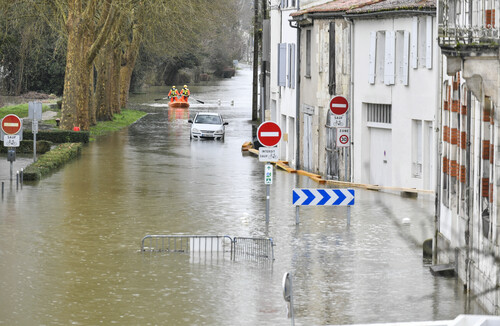
To complement flood prevention tools, a web application has been created collaboratively. It gives residents the keys to getting involved and protecting themselves more effectively.
Credit: DARRI / MAIF
To complement flood prevention tools, a web application has been created collaboratively. It gives residents the keys to getting involved and protecting themselves more effectively.“Everyone is affected.” This is one of the first sentences you read on the web application named “Flooding: taking preventive action”. The app can be used on both mobile and computer and includes a self-diagnostic tool, a quiz and resources to help you learn more.
It was created in response to a call for projects from MAIF Foundation for Research.
A multitude of players
This new digital tool was designed using a participatory method, in which all stakeholders were involved at every stage of the process. This diversity contributed to the project’s success: a multi-disciplinary team from the academic world, a local authority (Sorgues Basin Mixed Union), an environmental mediation consulting firm (Autrement Dit) to act as a link between contributors, MAIF Foundation for Research and, above all, target users, i.e. the citizens and professionals involved in risk management in their area.The purpose of the tool is to make residents aware of the risk and incite change.
Residential uses
One in four people live in flood-prone areas. But despite existing prevention initiatives, residents are not very aware of their individual vulnerability. The application is there to meet this need.
Users were asked to comment on the app's usability, as well as its perceived usefulness. They were involved in all the models, from the prototype to the final version.
Based on their feedback, behavioural sciences and digital and computer sciences were used in conjunction to create an innovative prevention tool.
Texts for this report were written by the Canévet et Associés based on interviews with the project’s leaders and partners.
Identity card of the participatory research
| Title of project: | Inondation, agir en prévention |
| Funding: | MAIF Foundation’s 2020 Call for Proposals: “Collective Approaches to Risk Prevention Put to the Test by Individual Behavior” |
| Objective: | Empower every citizen to take charge of their own safety in the event of flooding. |
| Partners: | With Isabelle Ragot-Court, Doctor of Social Psychology and Researcher at the Accident Mechanisms Laboratory at Université Gustave Eiffel and Marc Rigolot, Director of MAIF Foundation for Research. |
| Highlight: | |
| Key words: | |
| Deliverables and actions: | In progress |
