
Use the drop-down summary to access the articles in the folder.

Terms of republication
You can republish this article for free on your website, blog, etc.
Flooding: innovation born out of contributions
Behind the scenes of research
A multi-disciplinary team responded to a call for projects from the MAIF Foundation and worked with the Sorgues Basin Mixed Union and environmental mediation consulting firm Autrement Dit to create the web application “Flooding: taking preventive action”. Users were involved from start to finish, to ensure that the tool would meet its objectives as effectively as possible.
Faced with the declining effectiveness of collective prevention approaches, the project titled "Flooding: taking preventive action” provides a complementary tool for raising public awareness, changing attitudes and reducing risky behaviour.
Behavioural sciences in service of prevention
“Risk stakeholders and public decision-makers are increasingly convinced that prevention, risk management and even the return to normalcy can no longer be achieved without the involvement of citizens. Our aim is to raise awareness among as many people as possible and, above all, to get citizens to take action themselves,” explains Isabelle Ragot-Court, a Doctor in Social Psychology, Researcher at Accident Mechanisms Laboratory (LMA) at Université Gustave Eiffel and coordinator of the project team working with Sorgues Basin Mixed Union and consulting firm to respond to the call for projects from MAIF Foundation for Research.
LMA also joined forces with the Emerging Chronic Risks Laboratory at Université de Nîmes to co-supervise a doctoral thesis in social and environmental psychology, the research for which informed the app’s design and its evaluation by the target audience.
The call for projects was based on the observation that there is room for improvement around individual behaviour in response to risk situations. Its aim is to develop more individualised approaches to prevention, with a view to achieving greater effectiveness.
An app distributed by local stakeholders
The goal is for the new tool be used by as many people as possible, free of charge. The web application was created on the basis of social psychology and technological persuasion. “In the behavioural sciences, we have techniques that encourage safety-conscious behaviour. In digital and computer science, we have other navigation tricks to get people where we want them to go, for example, call-to-action buttons and virtual rewards,” explains Isabelle Ragot-Court.
The researchers also drew on the knowledge of those working in the field to develop the application’s content, as well as to disseminate it to the general public, given their close contact.
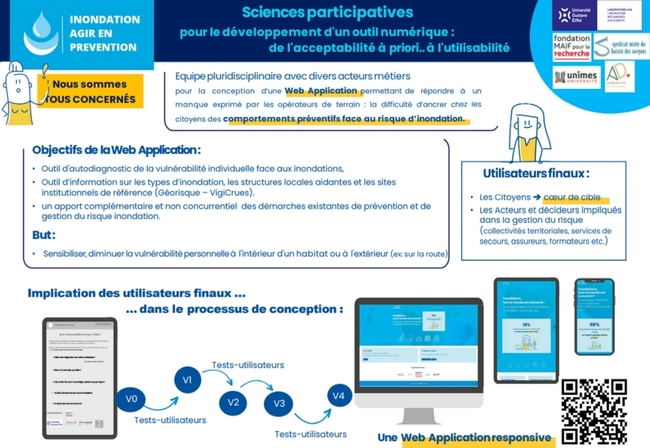
Credit: Inondation, agir en prévention
To ensure that the application was effective, local residents tested it at every stage. “The principle is to assume needs and levels of knowledge, and then readjust with feedback from users,” emphasises Marc Rigolot, Director of MAIF Foundation for Research.
The app provides practical information and suggestions for action in each situation. With the self-diagnostic tool and the quiz, users of the app come away with the right preventive actions and reflexes.
